Elizabeth gregorio, PhD
Research Scientist
Get to know me!
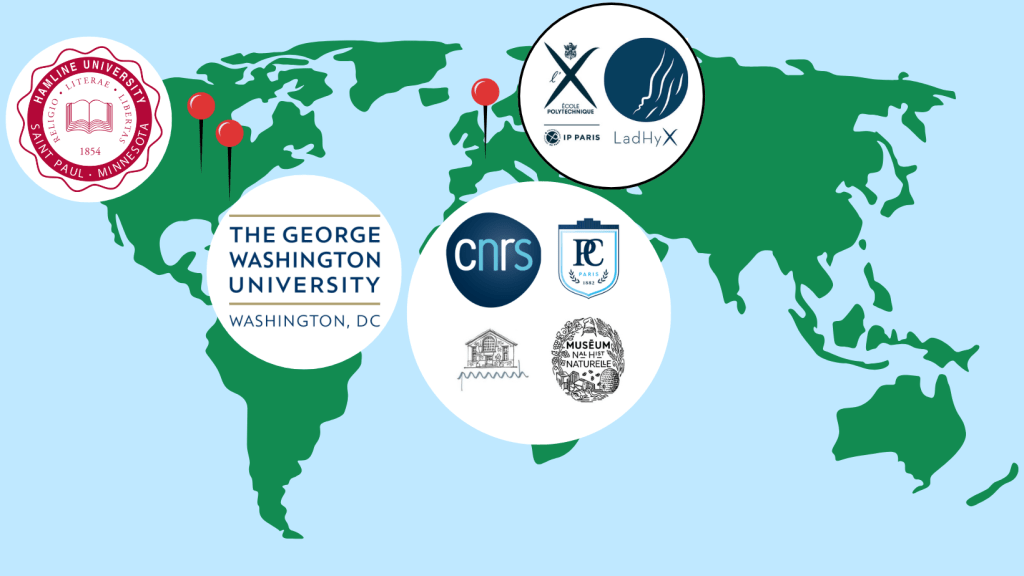
January 2024: PhD in mechanical engineering, The George Washington University, Washington, DC
May 2018: B.Sc. in physics with departmental honors,
Hamline University, Saint Paul, MN
OrcidID: https://orcid.org/0009-0001-4093-118X
Google Scholar Profile
Research Interests
My favorite research themes include fluid structure interaction and measuring physics on a “human” scale. I am passionate about using fluid dynamics and engineering as a lens to learn more about bio-locomotion and sports physics.
Currently, I am a postdoc at LadHyX at Ecole Polytechnique studying the physics of paragliding with Michael Benzaquen, Caroline Cohen, and Sophie Ramananarivo.
Previously, I was a postdoc at Laboratoire Physique et mécanique des milieux Hétérogènes (PMMH) in Paris where I am studying snake swimming hydrodynamics with Ramiro Godoy-Diana (PMMH) and Anthony Herrel (MNHN). A summary of this work can be found below.
In August 2023, I successfully defended my PhD in mechanical engineering! My research focused on understanding how Olympic divers reduce their splash by performing the rip entry. Some highlights of this work can be found below.
You can also check out my Work Outside the Lab for information about my outreach activities, seminars, and panels.
Snake Swimming Hydrodynamics
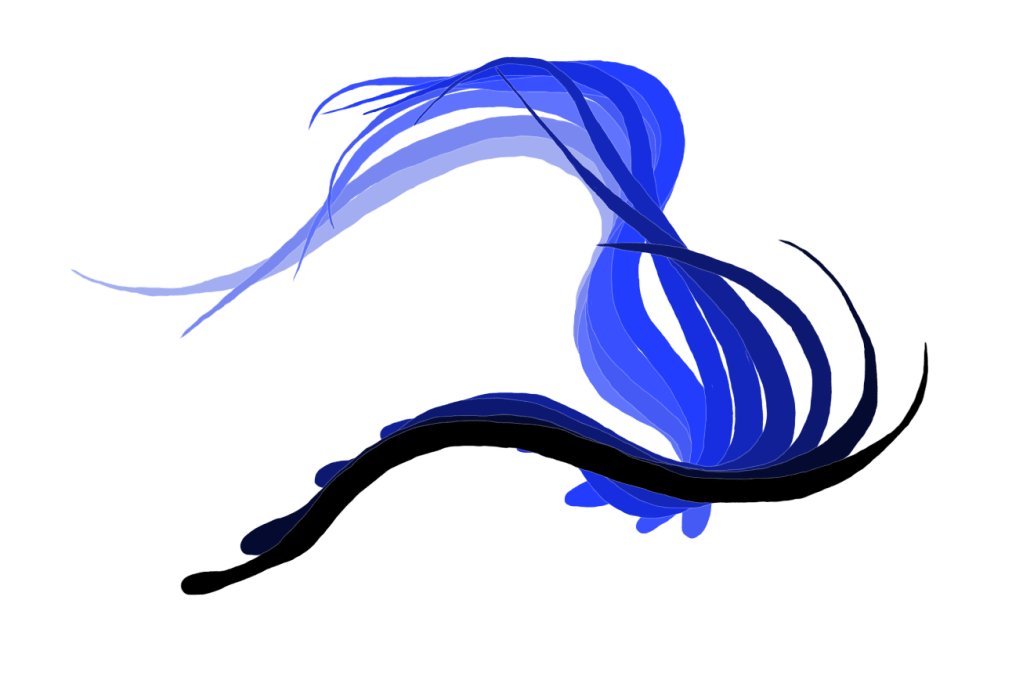
There are more than 4,000 snake species living around the world in a wide variety of habitats. This means that they also have a wide array of adaptations to their environments. Their relatively simple body shape and high maneuverability have made them a popular model for robotics, however, we know little about what makes them efficient at moving through and maneuvering when swimming.
We are conducting experiments with a wide range of snake species to investigate what morphological characteristics make snakes more or less efficient swimmers.
Publications:
Elizabeth Gregorio, Ramiro Godoy-Diana, Anthony Herrel. Turning without Fins: How Snakes Achieve High Maneuverability While Swimming. 2025. (Pre-print) ⟨hal-04876557⟩
PhD Work: the rip entry
Inspiration
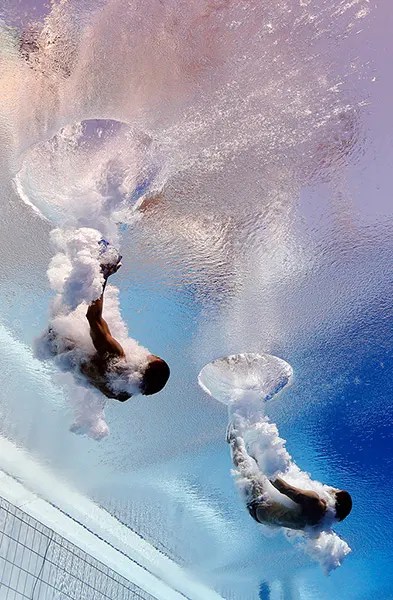
Competitive divers are able to achieve higher scores when they enter the water and create little to no splash and to do so they typically perform a rip entry. The rip entry is performed by impacting the water with their hands held flat before turning their body in a somersault.
In this way they are rapidly changing from a slender body to a bluff body underwater as well as rapidly decelerating. I investigated this with experiments and simulations, summaries of this work can be found below.
Featured in: Science News and This Week Junior
Experiments
I designed single jointed diver models and a driven entry body experimental setup to understand how a body that dynamically changes shape after impact changes the formation of the air cavity and splash.
Publications:
Elizabeth Gregorio, Elias Balaras, and Megan C. Leftwich. “Air cavity deformation by single jointed diver model entry bodies.” Experiments in Fluids 64.11 (2023): 168. ⟨hal-04875637⟩
Elizabeth Gregorio, Iftakhar Alam, Elias Balaras, Megan C Leftwich. Dynamically Deforming Single Jointed Diver Models Reduce Pinch off Depth. 2025. (Pre-print) ⟨hal-04876578⟩
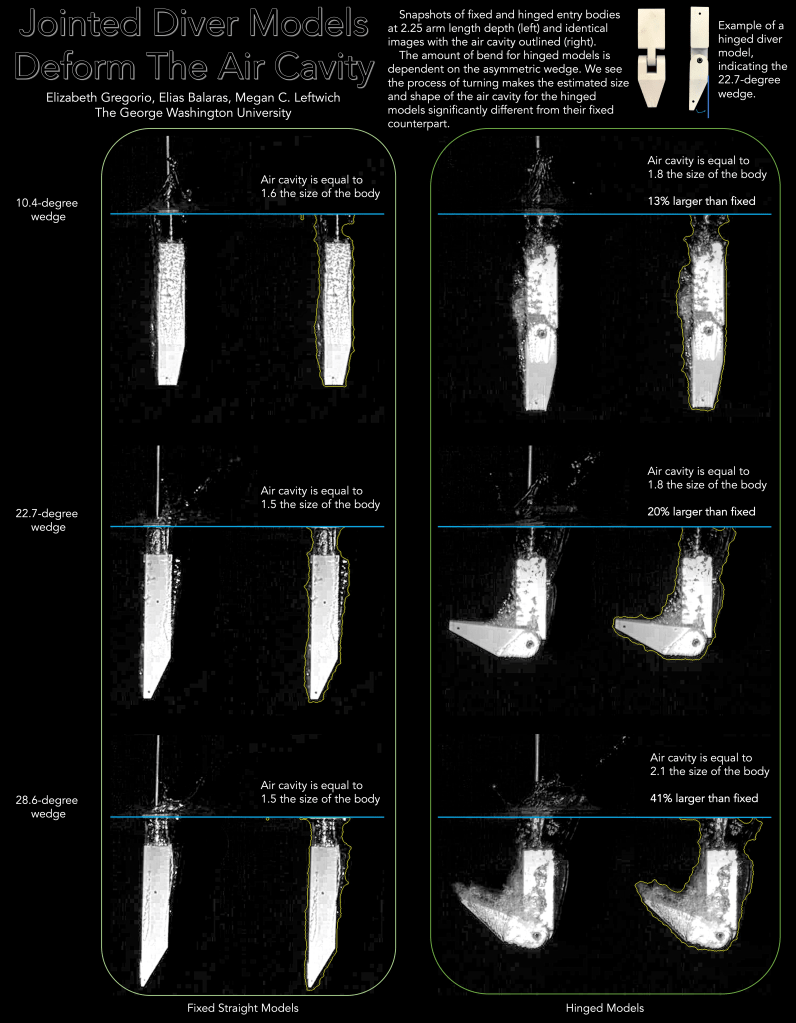
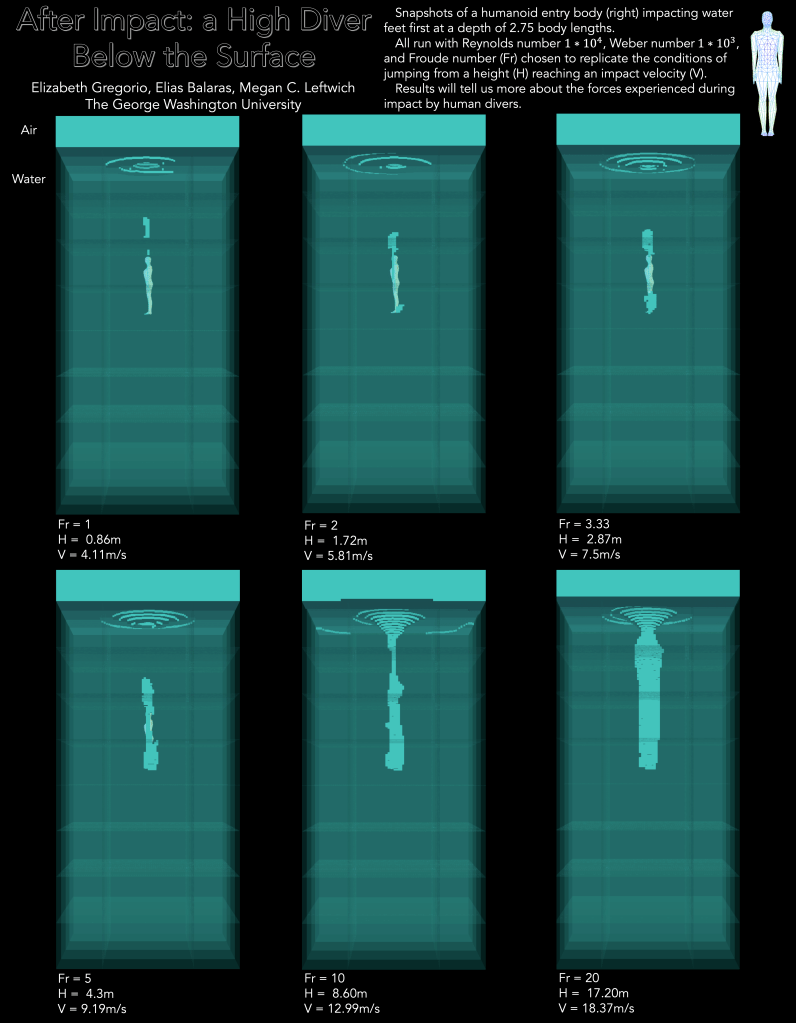
Simulations
I advanced the immersed boundary method force formulation for multiphase flows in Flash4 to to study sources of injury for cliff divers. This work was presented in a Gallery of Fluid Motion poster in 2022 (see left).
I integrated articulated immersed boundaries to perform simulations of my experiments to understand the relationship between the air cavity pinch off and splash production.
The results of my simulations studying the progression of the air cavity for rapidly decelerating entry bodies can be found in my dissertation.
 Elizabeth gregorio, PhD